
Curtains go up on the sixth edition of the Kochi Muziris Biennale this evening, ushering in 110 days filled with art in all its diverse expressions. Curated by painter and performance artist Nikhil Chopra, the Biennale themed For the Time Being will challenge conventional notions of ‘viewing art’. In place of the traditional one-sided viewing there will be performances, alongside artworks and installations, workshops and dialogues. The curation of this edition promises to be a vibrant art extravaganza featuring works of artists not only from Kerala and India, but from 25 countries will showcase their works here over the course of three months. Apart from the eight permanent venues there are 20-odd others which will host events such as Edam, Art By Children, Student’s Biennale, Invitations and Collateral Programmes.
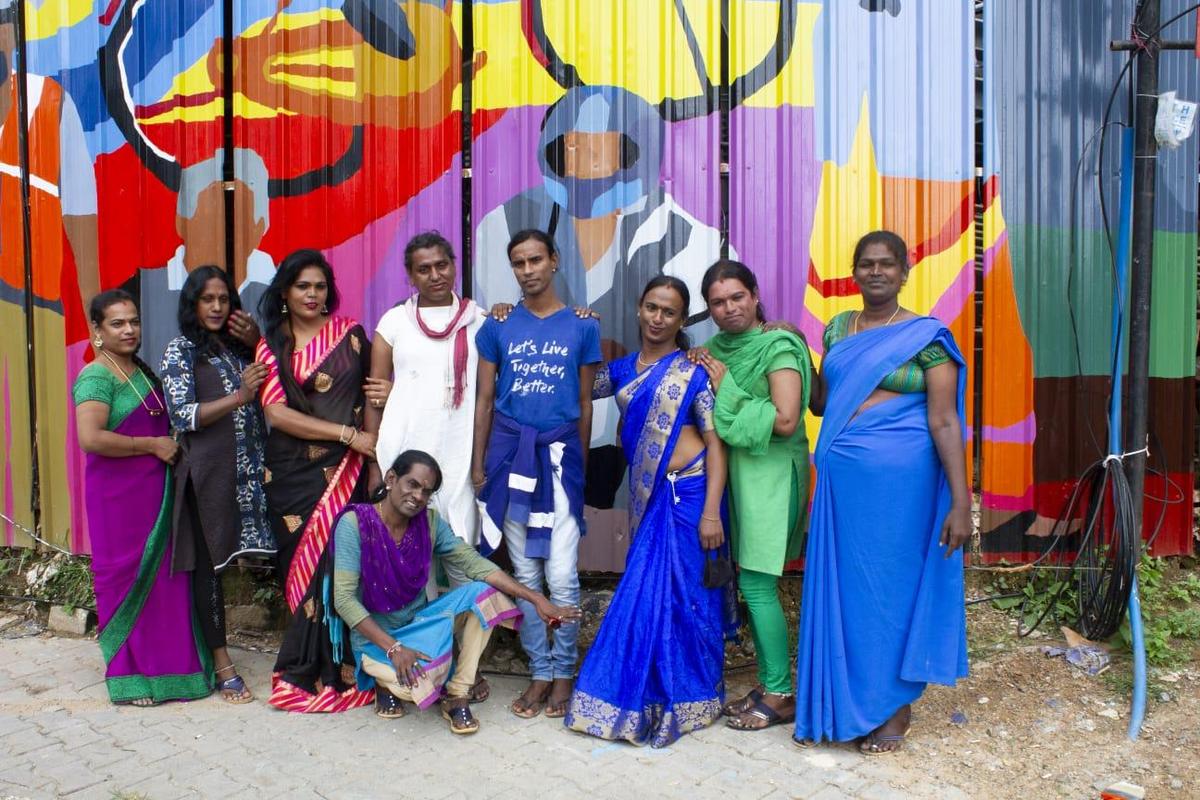
Members of the Aravani Art Project from the Island Mural Projects
| Photo Credit:
Special Arrangement
Into the public space
Island Mural Projects, conventionally, are community-focussed, large scale paintings that speak about the local history and culture. The KBF brings art to the public, literally, as some walls in Mattancherry and Fort Kochi will become canvases in conversation with the local communities, their and regional histories. The ‘first wave’ of mural artists will include the Aravani Art Project, a collective that derives its power from community and its creativity working alongside the transgender community — a way to make trans lives visible in the city. The others are multi-disciplinary artists Munir Kabani, Osheen Siva and Pardip Das who will be joined by another artists’ collective, Trespassers. At Women & Children’s Hospital (opposite VKL Warehouse), Mattancherry; Artshila Kochi; Palm Fibre (next to Aspinwall House); SIMI Warehouse; Cube Art Spaces.
Edam
Edam, showcasing the works of 36 artists and collectives from Kerala, will reflect the signs of our times — wars, exclusionary politics, caste, gender and displacement. Conceived in 2022, the second edition of Edam is Biennale’s platform for artists from Kerala and its diaspora. Curated by Aishwarya Suresh and KM Madhusudhan, Edam opens on December 13, 12 noon, at Armaan Collective and Cafe. Venues : Cube Art Spaces, Armaan Collective and Cafe, and the Garden Convention Centre in Bazaar Road, Mattanchery
Collaterals Programmes
Exhibitions, as part of the Collateral Programme, are selected to highlight emerging voices, regional contexts, overlooked histories, and experimental approaches. For the sixth edition of the Kochi-Muziris Biennale, Collaterals were reimagined through an open call format. Nine exhibitions were selected from over 150 applications. These are selected and recognised by the Kochi Biennale Foundation and independently organised outside the Biennale’s primary venues. In its new avatar, the intent of the Collateral Programme is to represent diversity while demonstrating the strength of curatorial thought and/or presentations of work that challenge the norm and represent cutting-edge ideas. These are a few shows with a Kerala connection. These open on December 14.
Like Gold — Ponn Poley, by UAE-based Rizq Art Initiative (RAi), traces journeys of gold – mythical, migratory and material – to the intertwined histories that spread across and geography spanning Kochi, the Malabar Coast and the Arabian Gulf. RAi, founded in 2023, is a social enterprise and independent art gallery which also runs artists and curatorial residencies, publishes, conducts workshops and other programmes. At KM Building, Calvathy Road, Fort Kochi.
The Emperor’s New Clothes — Raajavu Nagnanaanu by Kochi-based Monsoon Culture which unravels the Malayali identity and collective memory by bringing together artists and audiences. Monsoon Culture is a design-led research studio and collective founded by Aswin Prakash, which explores the intersection of craft, memory and advocacy. Through its projects, Monsoon Culture creates work that bridges memory, location and contemporary cultural expression. At Monsoon Culture, Jew Town, Mattancherry .
Looming Bodies, a photographic installation by Lakshmi Madhavan along with the Balaramapuram Weaving Community, explores the weaver’s body, as it labours, as a site of historical weight, repetition, resistance and memory. A conceptual artist, Lakshmi works between Kerala and Mumbai, collaborates with the weavers of Balaramapuram. At KM Building, First Room, Calvathy Road, Fort Kochi .
Parallax, presented by Forplay Society, is a space for being together – where the act of gathering is as important as what is made. The idea is about understanding the texture of being together in all its silence, contradiction, awkwardness and disagreement.
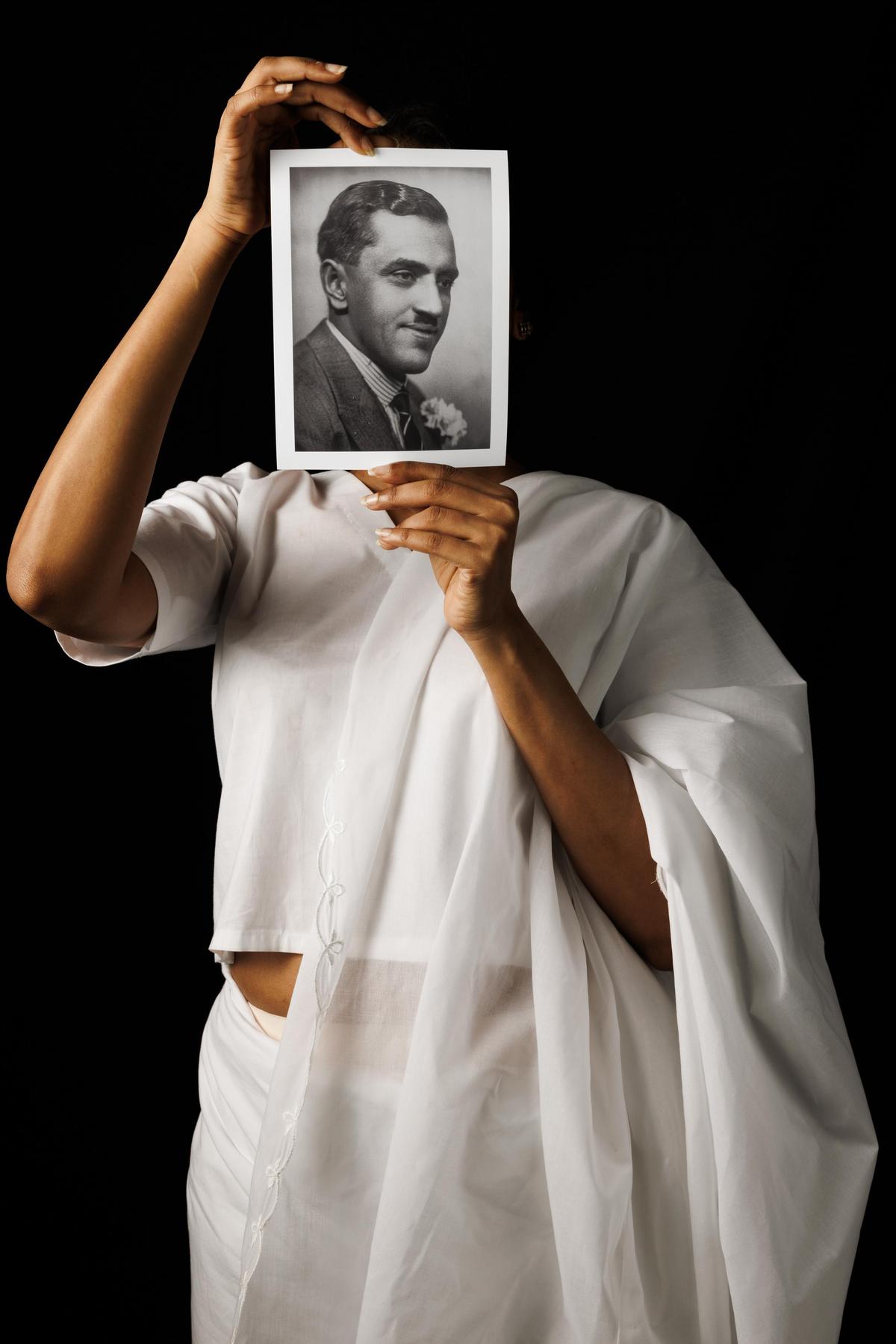
Lilies in The Garden of Tomorrow by Sarah Chandy from the Collaterals programme
| Photo Credit:
Special Arrangement
Lilies in the Garden of Tomorrow by Sarah Chandy, a multi-layered exhibition and research project, curated by Bakul Patki, portrays a significant period in the history of the Syrian Christian family the artist married into. Ten volumes of diaries written by Eliamma Mathen between 1938 and 1942 serve as inspiration for the work which represents five generations of collective memory honouring one woman’s story. Sarah is a London-based photographer and journalist, the focus of her visual practice are women, identity and community. At Arrow Mark, Jew Town, Mattancherry.
The sixth edition of the Students’ Biennale will be held across the VKL Warehouse, Arthshila Kochi, BMS Warehouse, St. Andrews Parish Hall and Space Gallery. Instead of a linear, Singular narrative the works at the Students’ Biennale represents multiple voices and representations. This is where “students curate themselves; and curators become collaborators”.
Opens on December 13.

Ghetto Biennale from the Invitations programme
| Photo Credit:
Special Arrangement
Invitations programmes
Conceived in 2022, Invitations is, well, an invitation to sharing space, extending infrastructure and sharing frameworks and resources materially and symbolically. The aim, through this, is recognition of the precarious work of formations and institutions elsewhere. “At the heart of Invitations is a simple proposition: to share space so that we may learn from each other’s methods, languages, and institutional forms,” states the KMB note. The primary spaces of the Biennale — historic warehouses shaped by centuries of maritime movement, primarily trade – are opened to likeminded institutions to stage exhibitions.
Alkazi Theatre Archives in collaboration with Alkazi Collection of Photography, Re: Staging 1990s (Delhi) (2025) is a selection of interlinked materials from Delhi Modern: The Architectural Photographs of Madan Mahatta, brochures from plays performed in Delhi in the 90s, and theatre texts written during the decade that allow us to read theatre as a public record of the everyday experience of larger historical events. The Alkazi Theatre Archives is a privately owned collection initiated in 2016, located at Alkazi Foundation for the Arts, New Delhi. At Jail of Freedom Struggle Tower, Fort Nagar, Fort Kochi .
Liberated Zone and Other Displays: Habitable Conversations with the Imaginary by Conflictorium, this exhibition understands liberation as a radical act of seeing differently—a way of attending to the histories, voices, and truths that have been overlooked or intentionally hidden. At Oottupura, Pazhayannur Bhagavathi Temple, Mattancherry.
Spectres of History (2025) by Atis Rezistans | Ghetto Biennale wants to showcase Haitian art by Atis Rezistans alongside the collaborative work generated by the Ghetto Biennale. The overall theme that emerged from the juxtapositions was how the telling of histories is inextricably entwined with performing the divine. At St. Andrews’ Parish Hall.
Scree | Nairobi Contemporary Art Institute, Peterson Kamwathi traces the intimatechoreographies through which history lives in the present. He presents charcoal and pastel drawings which emerge directly on building surfaces, depicting human figures in states of repose, movement, and congregation. These are drawn from his observations of life in his native Kenya as well as in Kochi. At David Hall.
An Instigators’ Handbook for Play, Friendship, Generosity, and Autonomy by Alice Yard was born out of one of their enduring concerns about ‘how to talk about what we do. How do we develop a critical vocabulary and syntax that are specific enough to be useful, yet flexible enough to permit a certain playful spontaneity? Alice Yard is a contemporary art space and collective based in the Port of Spain, Trinidad and Tobago. At Simi Waterhouse, Mattancherry.
Museo de Arte Contemporáneo de Panamá (MAC Panamá) proposes an edit of its ongoing exhibition, water binds me to your name, which approaches water as method, metaphor, and medium—an element that connects but also transforms histories, geographies, and diaspora. At Simi Warehouse.
With Inner Strength, Bienal das Amazônias chooses sprouting as its language. As action, rather than metaphor. Sprouting is a living process, between what has already been and what is still being done. It is the time of sap—slow, silent, but sure. At Devassy Jose and Sons, Mattanchery.
So We Could Come Back by Dar Yusuf Nasri Jacir for Art and Research is an exhibition tha ttraces migration – the movement of bodies, kinship networks, and sites of belonging, and traverses across the skies of the Global South through the works of four artists. At Devassy Jose and Sons.
The heavy weight of tiny little things (2021–ongoing) by The Packet strings together a series of observations into a continuous stream of paper emitted from a dot matrix printer. At Devassy Jose and Sons.
ruangrupa presents OK.Video (2003–ongoing), an evolving platform for media arts that has been active since 2003, emerging from Jakarta’s experimental art and activist movements. At Devassy Jose and Sons.
Khoj International Artists’ Association’s A Trilogy of Environmental Trials is an exhibition of a three-part project between 2016–2023, conceived by Khoj International Artists’ Association and Zuleikha Chaudhari, in collaboration with Advocate Anand Grover (for the first two chapters of the trilogy) and Advocate Harish Mehla (for the third chapter). Conceptualised as staged hearings with lawyers and judges, this exhibition presents petitions and testimonies, debating the question of how to measure loss, premising art as evidence and artists as witnesses. At Space, Indian Chamber and Commerce.
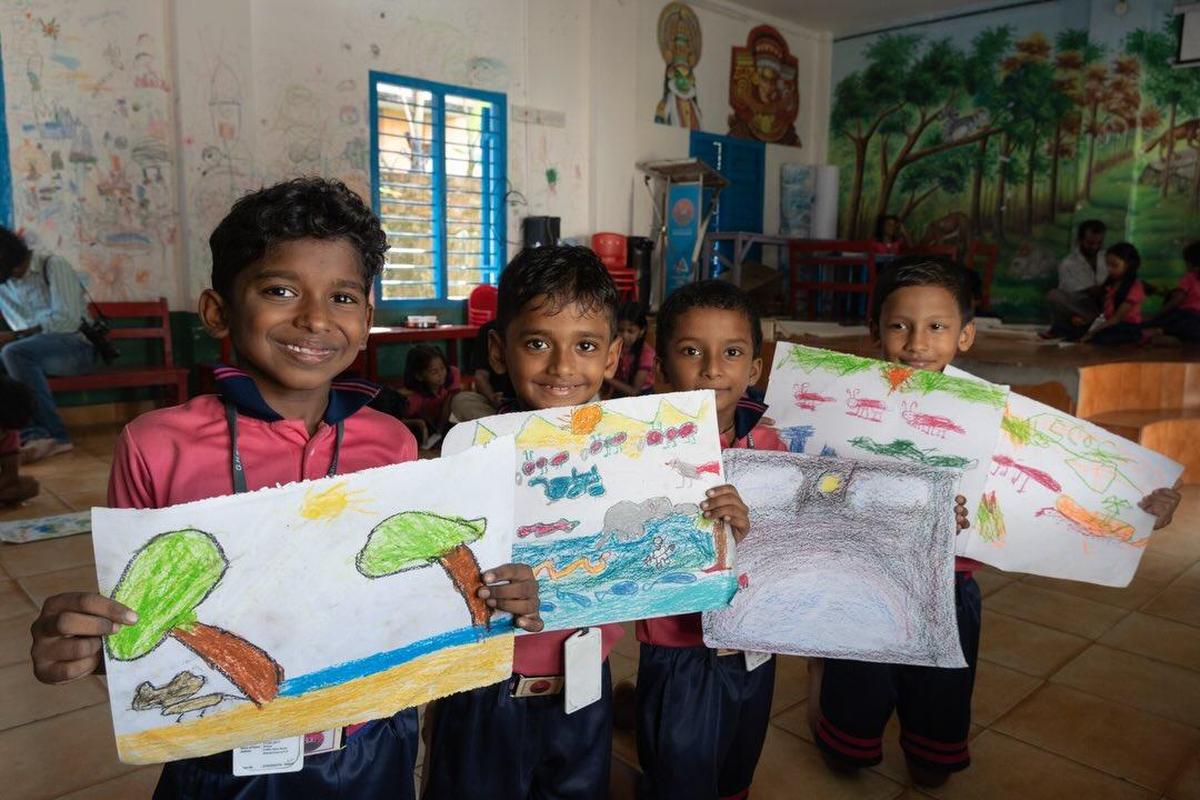
From an “art room”set up by the KMB
| Photo Credit:
Special Arrangement
Art By Children
A research-driven art education initiative by the Kochi Biennale Foundation, it seeks to cultivate an environment where art and creativity can flourish in a non-competitive, non judgemental, ecologically sensitive and joyful framework. It is designed for communities including children, parents and art educators among others. Launched in 2018, the Art Room project began by establishing dedicated “art rooms” in government schools in Ernakulam, Alappuzha, Thrissur and Palakkad districts. The Art Rooms at the biennale venues will host workshops led by Artist-facilitators. At The Art Rooms are at Water Metro, Fort Kochi and Bastion Bungalow.
At Durbar Hall Art Centre
This is Durbar Hall Art Centre’s first time as a permanent venue, though it has hosted collaterals and Edam in the previous editions. Veteran artist Gulam Mohammed Sheikh’s works will be on show here. It draws its inspiration from Gulam Mohammed Sheikh’s ever-expanding pictorial oeuvre, which defies the idea of a singular world or time. Sheikh has evolved a multidimensional practice through his engagement with modes of space-making, art historical referencing, and a socially reflective figuration, complimented by a pictorial language of storytelling and visual narration. Sheikh evokes a host of recurring figures such as Gandhi, Kabir, Saint Francis, Mirabai, and Mary Magdalene, amplifying their significance in these fraught times.